Buildings
HVAC plant, meters, lighting and access controllers over BACnet and Modbus — in the same inventory as the switches in the comms room.
IntegritIQ collects, normalizes and alerts on field equipment and IT infrastructure alike — BACnet, Modbus, SNMP, MQTT and LoRa — across buildings, campuses, plants, solar arrays and open land, from a console you run in the cloud or on site.
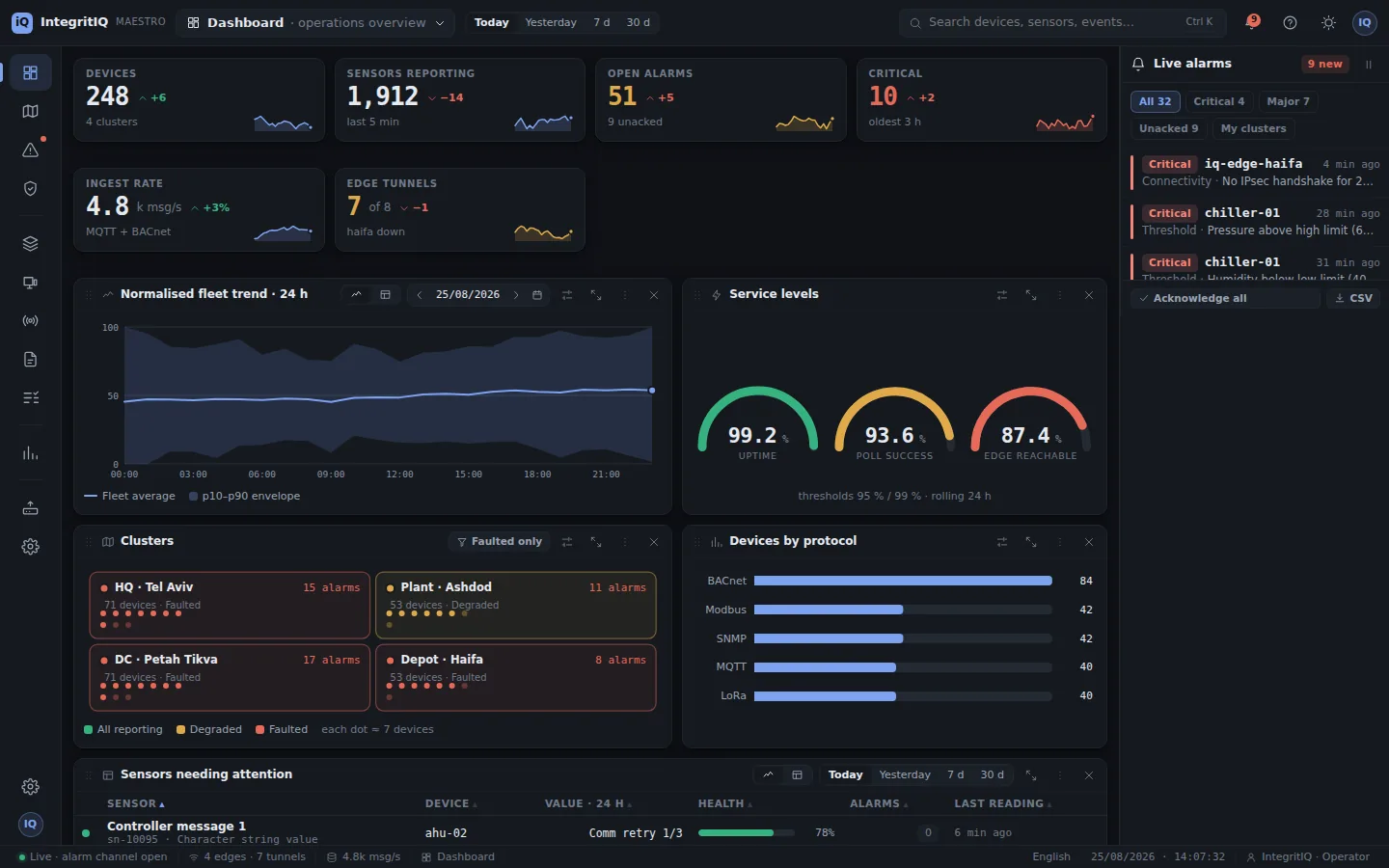
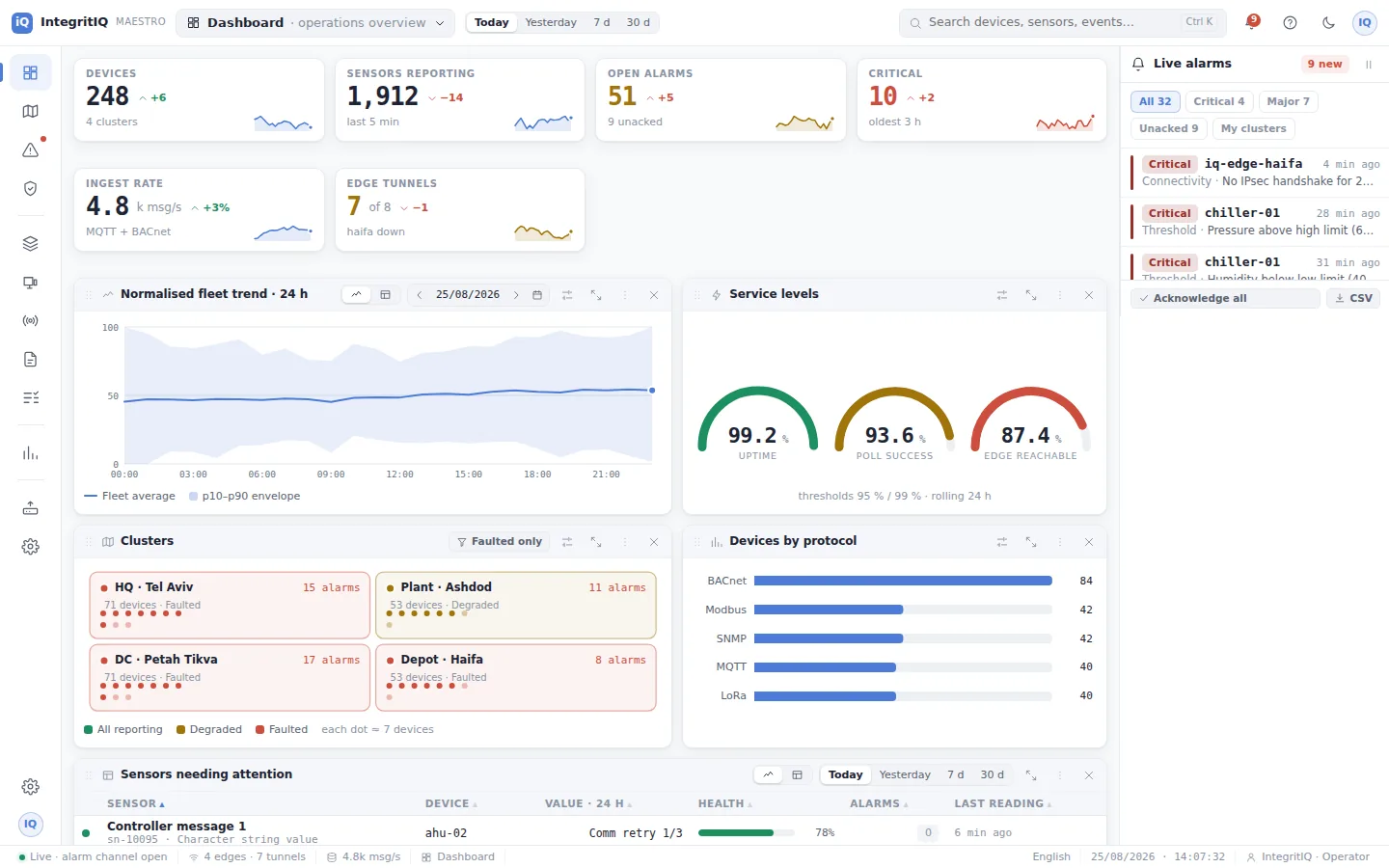
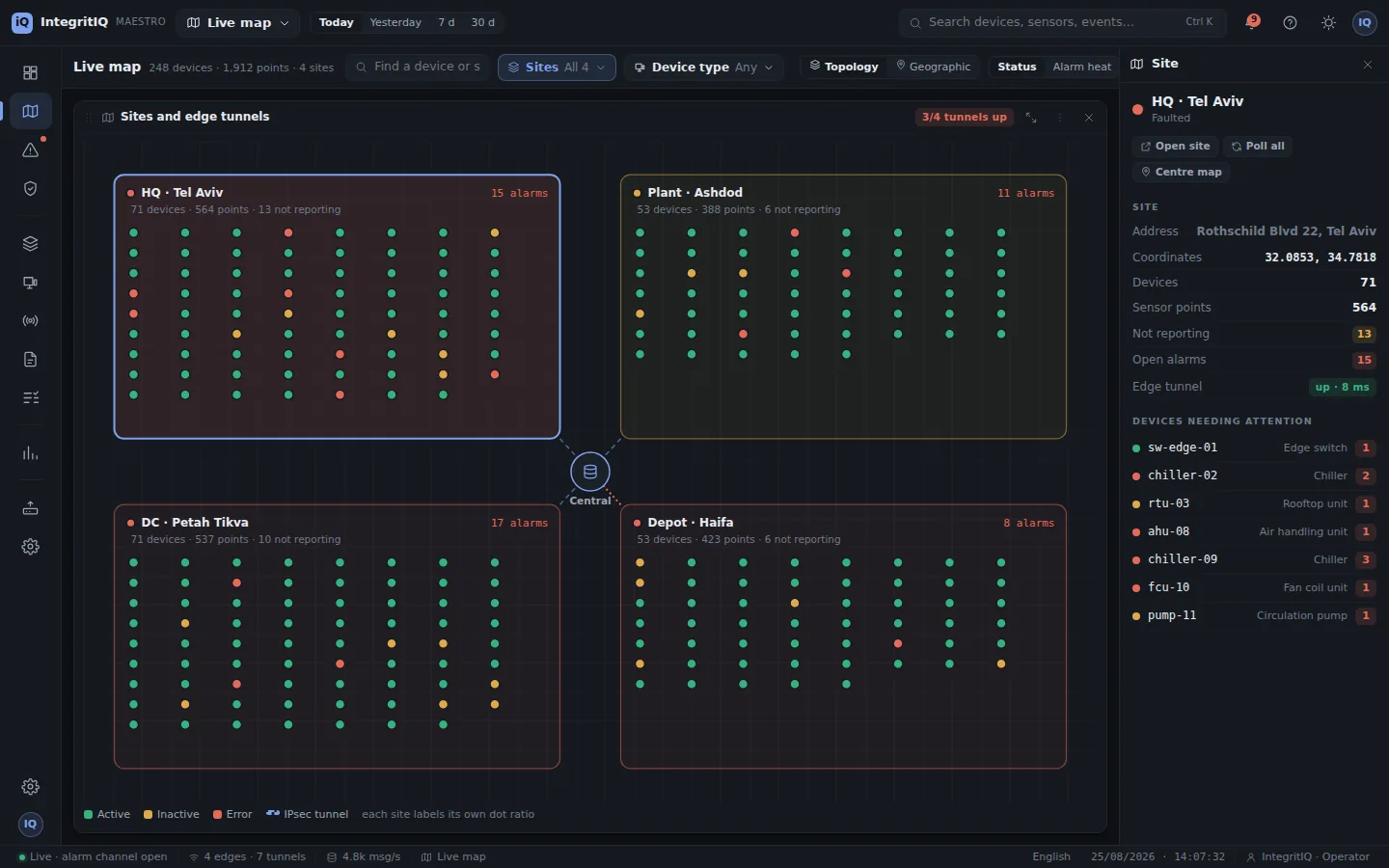
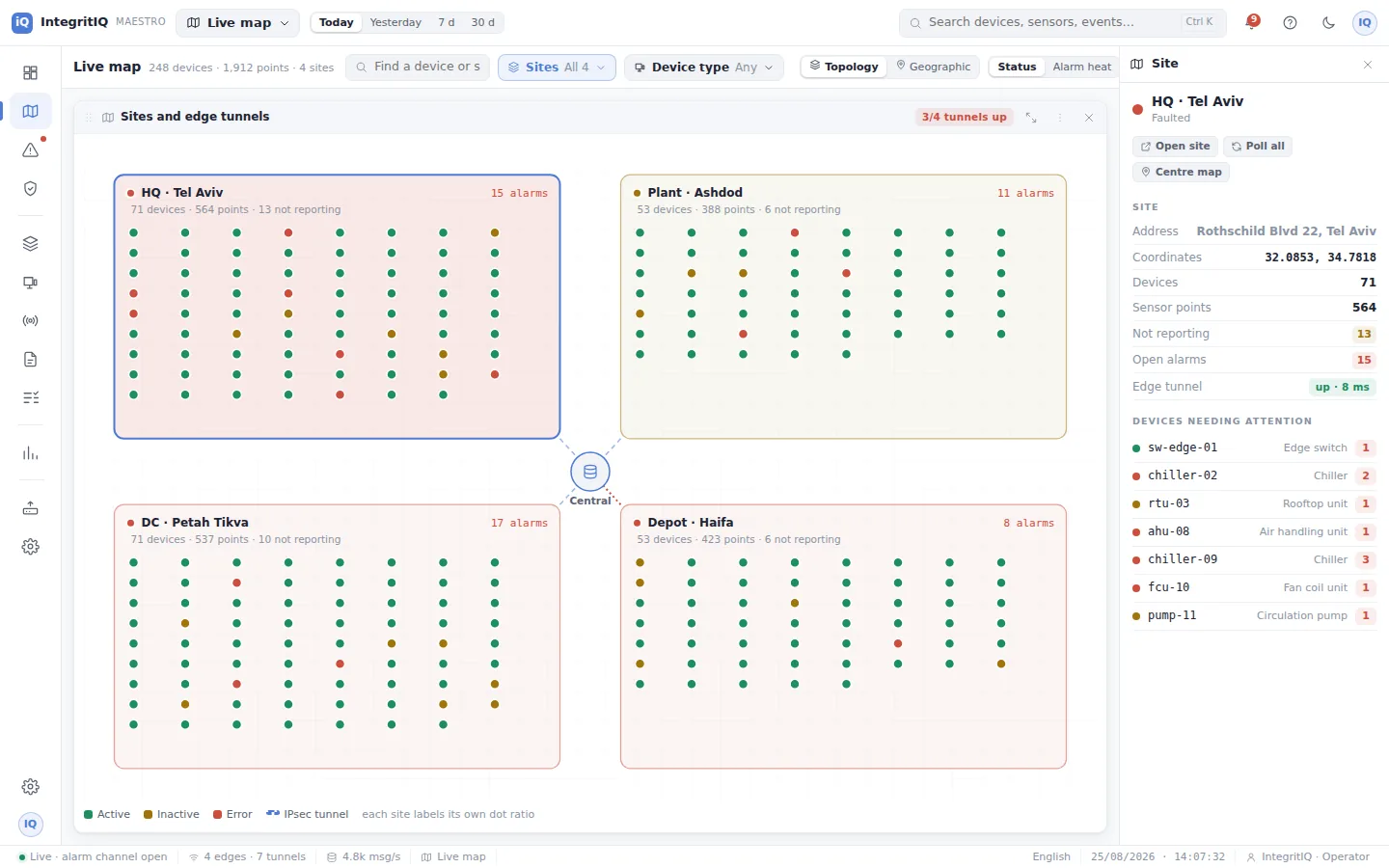
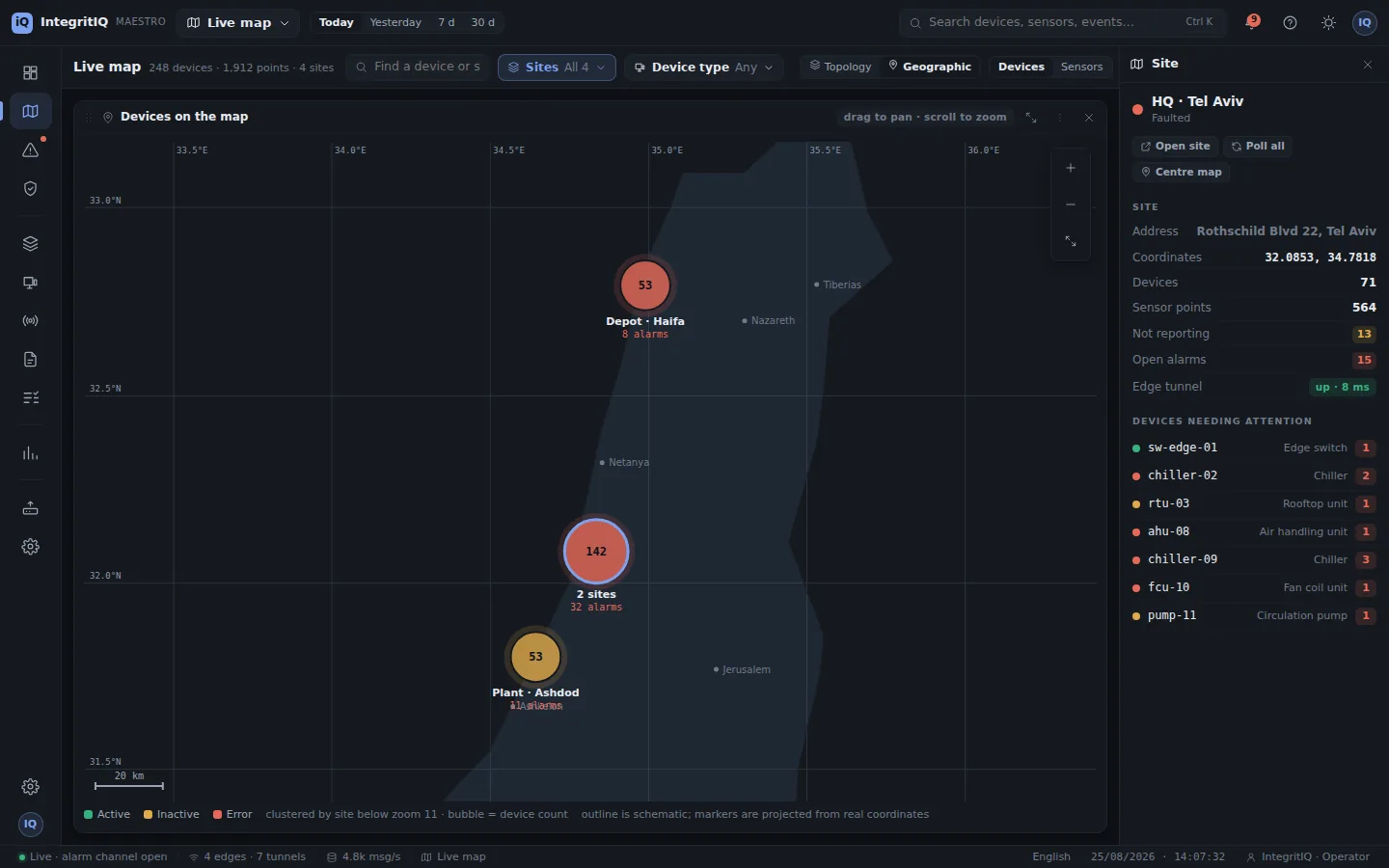
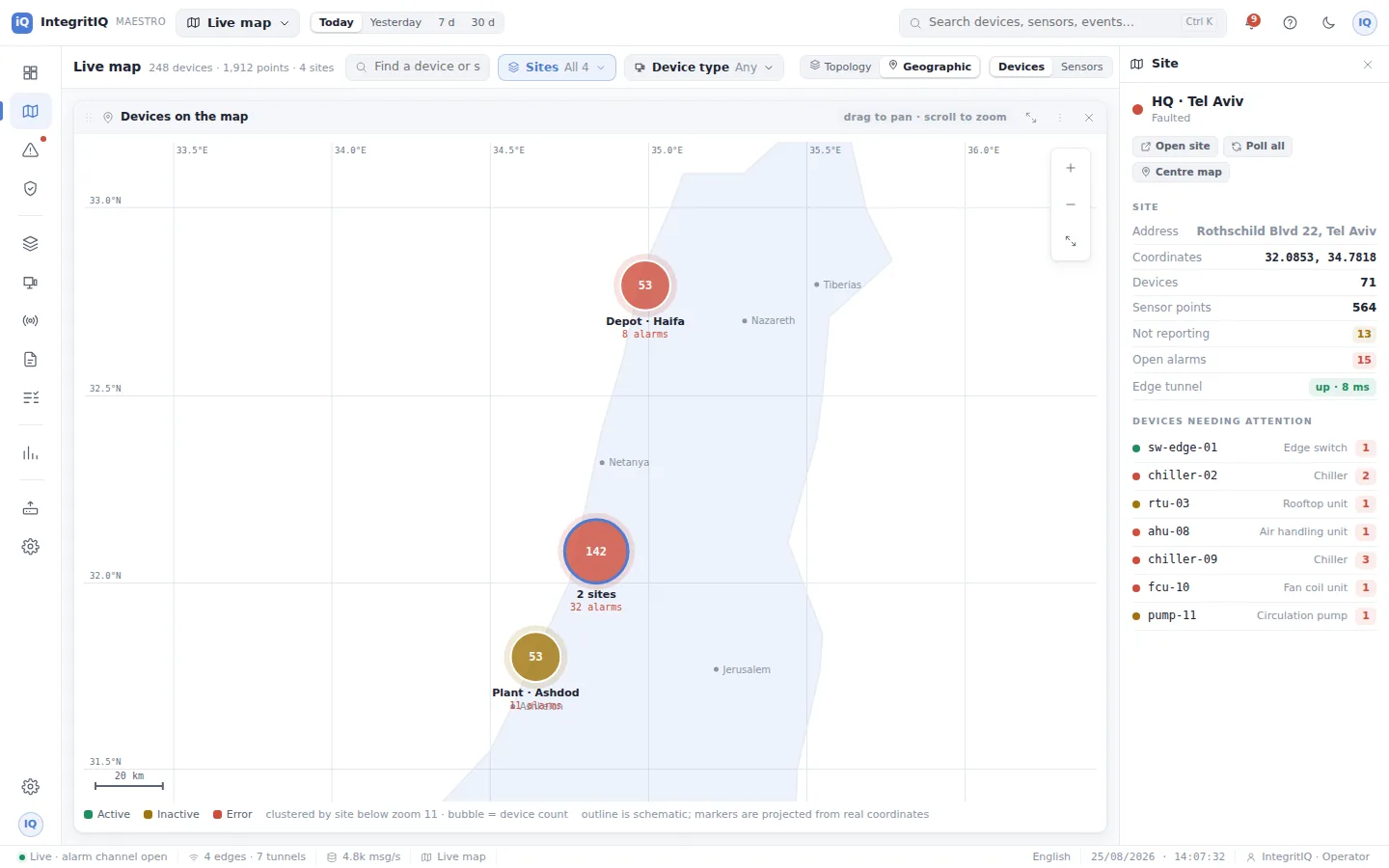
The core has no idea what a chiller is. It models devices, sensors and clusters that nest — so a riser, a building, a campus and a city are the same shape at different depths, and the vocabulary arrives with the templates you install.
HVAC plant, meters, lighting and access controllers over BACnet and Modbus — in the same inventory as the switches in the comms room.
Dozens of buildings under one hierarchy. Clusters nest and inherit their location from the parent, so a block, a building and a single riser each roll up without duplicating a device.
Street cabinets, pumping stations and remote kiosks, each behind its own edge appliance, reporting into one console over a tunnel the site opens outbound.
Modbus RTU over serial, controller registers and gateway points — polled locally and buffered on the edge appliance when the link to central drops.
Inverters, string boxes and generation meters speak Modbus. Every string becomes a sensor point with its own history and charts, beside the site’s own IT gear.
Soil, water and weather stations on LoRaWAN through ChirpStack, kilometres from the nearest switch, gathered by one gateway per area.
Anything that speaks a protocol in the catalogue fits — the platform is not written around one kind of site.
Run IntegritIQ as a service we host, on your own cloud, or on an appliance inside a plant with no internet at all. It is the same platform in every case — and when the link drops, collection, alerting and the console keep running on site.
Chillers, inverters, meters and field controllers sit beside switches, servers, firewalls and UPS units — unlimited sensors per device, nested groups, bulk operations, and queries indexed for hundreds of thousands of points.
Every integration reports a heartbeat, and unreachable equipment is marked offline rather than left showing its last good reading. The offline threshold is tunable, so slow buses don't flap.
Device templates and driver configuration are pushed from the console into each integration container — the same reconciliation loop whether the driver runs centrally or on a remote edge appliance.
Actions across devices, rules, users and settings are written to an append-only log against the operator who made them, kept for as long as you configure. Command execution on a device is recorded twice — once as an audit entry, once as an action record with its own outcome.
Aria is the assistant built into the console. Ask it in plain language about any device, sensor, alert or rule across every connected system — and when the answer is an action rather than a sentence, it prepares the action and hands it back for you to approve.
Create a rule: email the on-call engineer whenever a Haifa device goes offline.
Illustrative conversation. Aria changes nothing until someone approves.
A single question spans protocols, sites and edge appliances — which devices are offline in Haifa, what the chiller was doing before it faulted, which rules already watch this point. No query language, no walking page to page setting filters.
Every request Aria makes is re-checked against the roles and cluster scope of the operator who asked. An operator who cannot open a site cannot learn about it by asking instead — the assistant is not a way around the permission model.
Run a command on a device, write an automation rule, build a dashboard or a report — Aria drafts the change and returns it for explicit confirmation. Nothing it suggests takes effect until a person approves that specific action.
A scheduled plain-language digest of what moved across devices, alerts and integrations in the last day — the summary an operator would otherwise assemble by hand every morning before standing up.
Events arriving from integrations, and devices dropping off the network, run through rules you define — conditions on status, on any field in the event, on the time of day — and come out as email, an on-screen alarm with sound, or a webhook into whatever you already operate.
Per-rule cooldowns and hourly caps keep one flapping device from burying the console, and connectivity alerts close themselves when the device comes back rather than waiting for someone to tidy up.
Devices, sensors, groups, dashboards, users and roles. FastAPI and MongoDB behind a single interface that runs in the browser and on tablets, in English, Hebrew, Russian and Arabic.
A small appliance placed inside a client LAN. It polls local equipment, buffers readings, and forwards them to your central install over an encrypted IPsec tunnel it opens outbound — no inbound firewall rules, no public address at the site.
Protocol drivers ship as versioned container bundles on stable and dev channels. Adding a protocol means installing a bundle, not upgrading the platform.
Plant, field gear and IT infrastructure arrive the same way — a chiller over BACnet, an inverter over Modbus, a soil probe over LoRaWAN, a core switch over SNMP. One inventory, one alarm list, one set of dashboards.
A misbehaving field bus takes down its own container and nothing else. Drivers are restarted and reconfigured independently.
Drivers publish to a single internal contract, so a BACnet point, a Modbus register, an SNMP counter and a LoRa payload arrive as the same kind of sensor reading.
A new integration is a bundle that satisfies the contract. Nothing in the core changes to support one, including drivers we didn't write.
A device is not healthy just because it answers. Alongside readings and thresholds, IntegritIQ runs a security agent on the servers and workstations already in the inventory — and its findings arrive as ordinary events, in the same list your operators are watching anyway.
Install, restart or remove the security agent on a Linux host straight from its device page. No second console to log into, no per-machine scripting.
Detections land in the same list as a failed Modbus read, severity-mapped from the agent's own rule levels — one inbox, one acknowledgement flow, one history. The same rules that page someone about a chiller can page them about a host.
Agent status, last keepalive, events in the last 24 hours, and high and critical counts each become sensor points on the device, readable and chartable like any other. An agent that stops reporting drops off the network, and raises the same connectivity alarm any silent device would.
Commands that change a device are disabled by default and refused outright until an administrator turns them on. Every action that does run is written to an append-only audit log against the operator's name.
What a person is allowed to do and what they are allowed to see are decided independently. Roles grant capability; cluster membership grants scope. Granting someone a second site never widens what they can do there, and promoting them never widens where.
Local accounts with bcrypt, OAuth2 against Google or Microsoft, or your existing LDAP directory — mixed freely within one install.
Appliances ship closed: 22, 80 and 443 only, enforced at both the host firewall and the container layer. Anything else — a partner's broker, a direct feed — is an explicit, named exception.
Edge appliances reach central over an encrypted IPsec tunnel, initiated from the site. The remote network exposes nothing to the internet and needs no static address.
Nothing to install and nothing to patch. Your sites reach a console we operate, over the same encrypted tunnel an on-site install would use.
Any current Ubuntu or Debian machine — a cloud instance or a box in the plant room. The installer pulls the stack, generates credentials and brings the console up.
A single ISO that installs Ubuntu and the full stack unattended on bare metal or a VM. Every image is bundled, so first boot needs no internet at all.
One central install — hosted or your own — with an edge box at each site. Sites are enrolled, configured and health-checked from the same console that shows their sensors.
Tell us what you run — a chiller plant, a data floor, a solar field, forty branches — and we will show you the console with your protocols in it.